The Supreme Court said that merely because the complainant is a member of a Scheduled Caste or Scheduled Tribe is not enough to accuse someone under the SC-ST (Prevention of Atrocities) Act
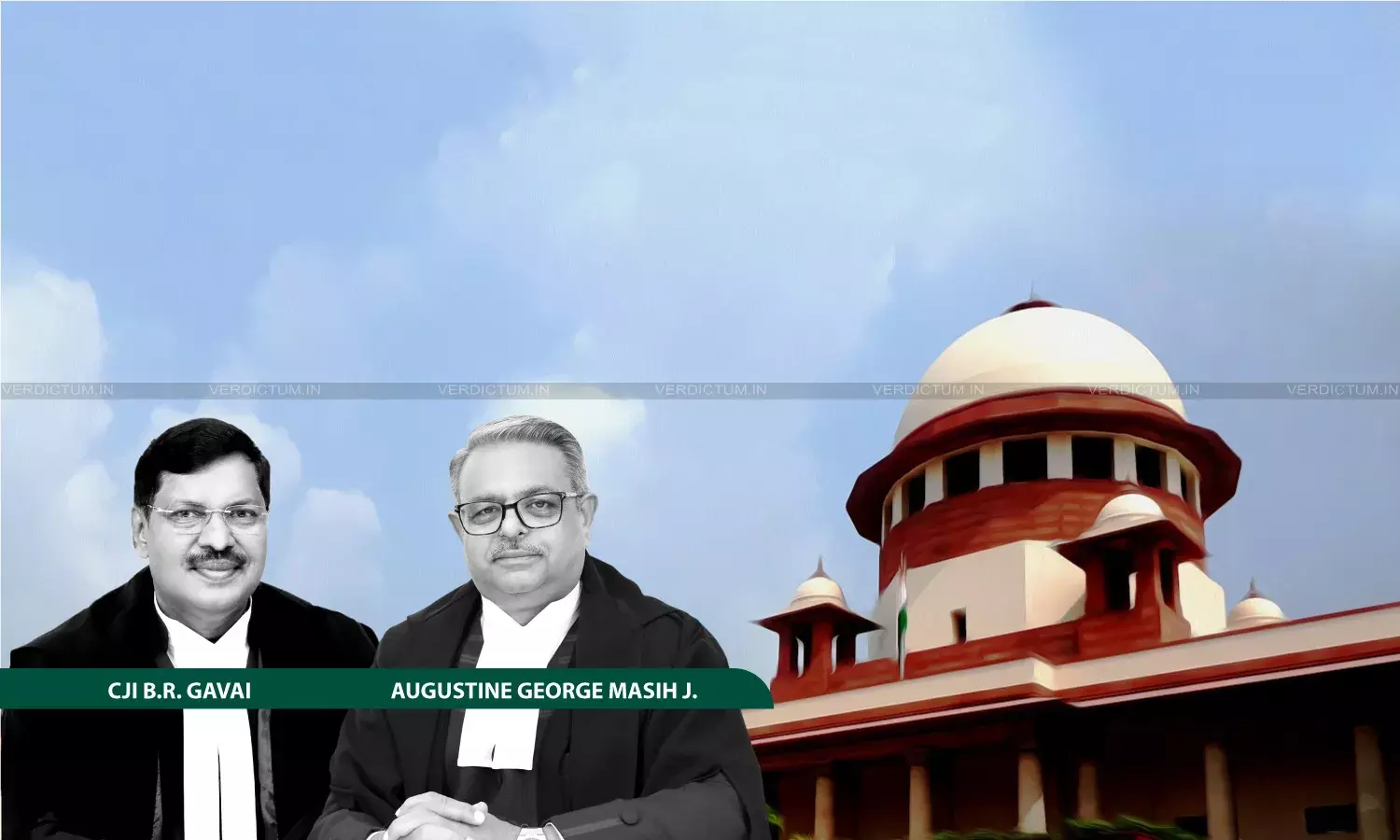
The appeal to the Supreme Court was against the Telangana High Court's decision to allow the accused persons' petition under Section 482 of the CrPC. The Supreme Court emphasized again that just because the complainant is a member of a Scheduled Caste or Scheduled Tribe does not mean that they can be prosecuted under the Scheduled Castes and the Scheduled Tribes (Prevention of Atrocities) Act. The Apex Court heard an appeal against the Telangana High Court's decision to allow the Respondents-Accused's Petition under Section 482 of the Code of Criminal Procedure (CrPC) in a case registered under Section 3(1)(viii), (ix), and (3)(2)(vii) of the Scheduled Castes and the Scheduled Tribes (Prevention of Atrocities) Act, 1989 (SC/ST Act). The High Court threw out the case against them. The Division Bench of Chief Justice of India B. R. Gavai and Justice Augustine George Masih said, "Looking at the complaint, it seems that the complaint was not really about the false and malicious involvement in the criminal proceedings against the Appellant and his family members because they belong to Scheduled Caste." The prosecution has not made out the crimes for which it is being charged. "For the crimes that the private respondents are accused of committing to be proven, specific instances and incidents supported by evidence are needed, which are not present in this case," it added. Advocate R. Chandrachud was the Appellant's lawyer, and Advocate Selvam P was the Respondent's lawyer. Factual Background: The case originated with a land allotment dispute in Duvva village. The Appellant claimed that Respondent 2, the Mandal Revenue Officer, and Accused 3, the proprietor of the Ramakrishna Cine Theatre in the same village, manipulated the allotment of two plots that were supposed to go to Scheduled Caste/Scheduled Tribe beneficiaries to upper caste people close to him. The Appellant protested to this allotment, which is believed to have led to his fictional involvement in a criminal case as part of a scheme in retaliation to the action taken against Respondent 2 after the Appellant complained about the unfair assignment of the plots. The Supreme Court said again that a plea of juvenility can be made in any court at any time. After the Appellant was declared not guilty and the prosecution dismissed the case, the Appellant filed a complaint against the Respondents and Accused 3. It was alleged that the second Respondent, who was upset with the Appellant, and Accused 3, whose family were the ones who won the allotment, all three of them blamed the Appellant and his brother. Allegations relating humiliation, harassment and the commission of violations under the Scheduled Caste and Scheduled Tribe (Prevention of Atrocities) Act, 1989 were made. The Case was committed to the Special Court. The High Court proceeded to allow the petition thus submitted, by quashing the proceedings, which led to the filing of the instant appeal. Also Read - Second Quashing Petition Not Maintainable On The Same Ground That Were Available To Be Raised At The Time Of First Petition: Supreme Court Reasoning The Bench, at the outset, noted that the first Accused had expired and vide an order, the name of the first Respondent was deleted from the array of parties at the request of the Appellant and upon his application. On a perusal of the circumstances of the case, the Bench noted that the prosecution commenced against the private respondents was founded upon a complaint submitted by the Appellant on the dropping of and the withdrawal from prosecution in criminal matter qua him. It was at that stage that the charges of mala fide and unjust prosecution at the request of Respondent 2, the MRO, and Accused 3, proprietor of Ramakrishna Theatre was raised. The first Respondent fraudulently identified the Appellant and his younger brother as an accused in the rioting case connected to the confrontation between two groups belonging to the Scheduled Castes. Also Read - Supreme Court Issues Notice In Terror Organisation Leader Alemla Jamir’s Bail Plea In Terror Funding Case It was evident that the allotment made by the second Respondent was as per the government directives and the cancellation of allotment had taken place. Therefore, there was no justification as to why the second Respondent would attempt to malafidely involve the Appellant and his family in the case. Reference was also made to the verdict in n Masumsha Hasanasha Musalman v. State of Maharashtra (2000) where the Court has highlighted that only because the complainant belongs to the Scheduled Castes or Scheduled Tribes cannot be the sole foundation for prosecution. “...since it was admittedly a dispute between two groups belonging to the Scheduled Caste, and the clash was not with any other community, rather intra-caste, involvement of the Appellant because of him being a Scheduled Caste in the criminal case does not arise, what to say of mala fide. No evidence has been presented on record which would indicate mala fide purpose on the part of Respondent No. 2 or any connivance. The bald charges against the Appellant would not in itself be sustainable”, it held. Thus, confirming the verdict of the High Court, the Court dismissed the appeal. Cause Title: Konde Nageshwar Rao v. A. Srirama Chandra Murty & Anr. (Neutral Citation: 2025 INSC 886) Appearance Appellant: Advocates R. Chandrachud, Ramesh Allanki, AOR Aruna Gupta, Advocate Syed Ahmad Naqvi Respondent: Advocate Selvam P, AOR S. Gowthaman, Advocate Prerna Singh, AOR Guntur Pramod Kumar, Advocates Dhruv Yadav, Dhananjay Dutta Shrimali Click here to read/download Judgment Chief Justice of India B. R. GavaiJustice Augustine George Masih Tulip Kanth Assistant Editor Tulip Kanth is an Assistant Editor at Verdictum having over 5 years of experience in the field of legal journalism and editing. She thoroughly covers judgments of the Supreme Court, High Courts as well as Tribunals. She has previously worked with a legal publishing website where she handled the work of other editors and has also published updates on notifications of different Government Ministries. She possesses an English Honours Degree from SGTB Khalsa College, Delhi University and has completed her LLB course with specialisation in Corporate Law from Amity University. Next Story Advocate Moves Supreme Court Seeking Inclusion Of Political Parties Under Sexual Harassment Law, Seeks Mandatory ICCs Across All Party Units The petition seeks legal recognition of political parties as “employers” under the POSH Act and says their exclusion creates a gap that violates women’s fundamental rights and enables a culture of silence. ByNamrata Banerjee|24 July 2025 6:15 PM Advocate Yogamaya M.G. has petitioned the Supreme Court under Article 32 of the Constitution seeking instructions to enforce the applicability of the Sexual Harassment of Women at Workplace (Prevention, Prohibition and Redressal) Act, 2013 (POSH Act) to all recognised political parties. The appeal seeks the Court to compel the creation of Internal Complaints Committees (ICCs) in every political party office and unit, to preserve the rights of women officials, volunteers, and workers. The petition states that the continuous exclusion of political parties from the statutory mandate of the POSH Act has resulted in a systemic vacuum for addressing accusations of sexual harassment suffered by women inside political organisations. The petition states, “Political parties remain outside the statutory framework of the PoSH Act, leaving a large section of women—functionaries, workers, volunteers, interns, and office staff—without any institutional redressal mechanism for sexual harassment complaints. The exclusion of these women from protection under the law violates their constitutional rights under Articles 14, 15, and 21 and undermines the purpose of the PoSH Act.” The petition states that the present writ petition was preceded by another writ, which was disposed of by the Supreme Court with liberty to the Petitioner to approach the Election Commission of India. A official representation dated March 17, 2025, was made, but no answer has been received so far. The petition records, “The Petitioner had earlier filed W.P. (C) No. 816 of 2024 before this Hon’ble Court seeking directions to include political parties within the jurisdiction of the PoSH Act and to require the creation of Internal Complaints Committees (ICCs) within political parties. This Hon’ble Court vide order dated 09.12.2024 asked the Petitioner to send a communication to the Election Commission of India. The Petitioner officially submitted a representation dated 17.03.2025 to the Election Commission. However, till date, no response or action has been initiated by the Respondents, necessitating the present writ petition.” The petition questions the Kerala High Court’s decision in Centre for Constitutional Rights Research and Advocacy v. State of Kerala (2022), which declined to extend POSH obligations to political parties in the absence of an employer-employee relationship. The petition states, “The Hon’ble High Court in its judgment dated 17.03.2022 held that political parties are not required to establish ICCs under the PoSH Act in the absence of a formal employer-employee relationship. This narrow understanding of the Act creates a severe vacuum in the protection of persons, particularly women, from sexual harassment within these organizations. By not mandating ICCs for political parties, the judgment inadvertently shields perpetrators and undermines the spirit of gender equality and justice.” The petition further asserts that a purposive interpretation of the statute is required to give effect to its aims, particularly in contexts where formal employment is absent but organised working relationships and power hierarchies exist. It states, “Given the evolving nature of workplaces and the diverse ways in which individuals contribute to political parties, a purposive interpretation of the PoSH Act is warranted.” The petition notes that political parties are not private bodies but public institutions that play a central role in governance, policy, and democratic participation. It continues, “Political parties are not merely private associations; they play a public role in shaping governance and public policy. They are recognised entities under the Constitution and the Representation of the People Act, 1951. They also receive public assistance in the form of tax incentives, subsidies, and access to government-provided infrastructure. Therefore, they must be held to constitutional standards and be required to ensure a safe and secure workplace for all individuals associated with them.” Invoking India’s commitments under international law, the petition refers to CEDAW, the ICCPR, and guidance by the United Nations and the Inter-Parliamentary Union urging proactive measures to address sexual harassment in political spaces. The petition further underlines that the continual lack of ICCs within party structures fosters impunity and silences complainants, writing, “The absence of ICCs in political parties creates a culture of silence and fear, where women are discouraged from coming forward with complaints. This perpetuates inequality and violates the principles of dignity and equality enshrined in the Constitution.” The petition seeks the following reliefs: “(i) Issue a Writ of Mandamus or any other appropriate writ, order or direction, declaring that political parties are bound to follow the procedure for protection of women in the workplace under the Sexual Harassment of Women at Workplace (Prevention, Prohibition and Redressal) Act, 2013. (ii) Issue a Writ of Mandamus or any other applicable writ, order or direction to construct a grievance redressal mechanism against sexual harassment as per the orders of this Hon’ble Court in Vishaka v. State of Rajasthan [(1997) 6 SCC 241] and in compliance with the PoSH Act, 2013. (iii) Issue a writ, order or direction to the Union of India and the Election Commission of India to classify political parties as “employers” under Section 2(g) read with Section 2(f) of the PoSH Act, 2013, thereby mandating the constitution of Internal Complaints Committees (ICCs) within political parties to ensure a safe and secure workplace for women functionaries, employees, staff, and volunteers.” Cause Title: Yogamaya M.G. v. Union of India & Ors. (Diary No. 39052/2025) POSH ActICC Namrata Banerjee Supreme Court Correspondent Namrata is a Correspondent covering the Supreme Court of India. She has previously practiced law and worked in-house with a Public Sector Undertaking. Next Story Plea Of Juvenility Can Be Raised Before Any Court At Any Stage: Supreme Court Reiterates The appeal before the Supreme Court was preferred against an order passed in the year 1993, whereby the Appellant-accused stood convicted and punished under Sections 342 and 376 of the IPC. ByTulip Kanth|24 July 2025 5:45 PM Chief Justice of India B. R. Gavai, Justice Augustine George Masih, Supreme Court While reiterating that the plea of juvenility can be raised before any Court, the Supreme Court has upheld the conviction of a rape accused but set aside the sentence imposed by the Trial Court and upheld by the High Court. The Apex Court has now sent the matter to the Juvenile Justice Board. The appeal before the Supreme Court was preferred against an order passed in the year 1993, whereby the Appellant-accused stood convicted and sentenced under Section 342 of the IPC (wrongful confinement) for a period of 6 months' rigorous imprisonment and under Section 376 (rape) for rigorous imprisonment of 5 years. Rejecting the argument of the State that it was not permissible to raise the plea of juvenility for the first time before the Apex Court, the Division Bench of Chief Justice of India B. R. Gavai and Justice Augustine George Masih said, “...the same needs to be merely mentioned to be rejected in light of the authoritative judgments passed by this Court starting from Hari Ram v. State of Rajasthan and Another followed by Dharambir v. State (NCT of Delhi) and Another (Supra), where it has been categorically held that the plea of juvenility can be raised before any court and has to be recognized at any stage, even after disposal of the case. It has further been held that such a claim is required to be determined in terms of the provisions contained in the 2000 Act and the Rules framed thereunder, i.e., the 2007 Rules, even if the juvenile has ceased to be so on or before the date of commencement of the 2000 Act, as in the present case.” AOR Vishwa Pal Singh represented the Appellant while Additional Advocate General Sansriti Pathak represented the Respondent. Factual Background The appellant had allegedly conducted rape upon an 11-year-old girl on November 17,1988. The victim related the entire scenario to her mother, and the complaint was lodged.
Arguments The appellant had presented arguments with regard to the irregularities in the prosecution case by noting that the First Information Report was recorded after about 20 hours after the supposed occurrence of the incident. Another point, which had been put up for the first time before the Apex Court was that the Appellant-accused was a juvenile at the time of the claimed event and the proceedings could not sustain. Reasoning Considering the factual features of the case, the Bench noted that the police station was at a distance of 26 km from the house of the victim and the FIR was lodged after a few hours. As per the Bench, the delay in lodging the FIR has thus been sufficiently explained. The same day, the medical examination of the victim was undertaken, and the potency test of the accused-appellant was conducted, which established the appellant’s competence of having sexual intercourse. On the question of placing trust upon the single testimony of the prosecutrix for conviction, the Bench stated, “Thus, the settled legal position is that the statement of the prosecutrix, if worthy of credence, requires no corroboration and can form the sole basis for conviction. Furthermore, in the present case, the prosecution’s case is not founded solely on the testimony of the victim; rather, it is amply supported by the statements of other witnesses and corroborating medical evidence, all of which collectively establish the case of the prosecution.” The Bench next dealt with the plea of the Appellant that he was a juvenile when the incident had taken place. The Bench noted that based on the statements of the witnesses and the materials produced, including the school records, his date of birth, reflected as September 14, 1972, and the same had been accepted to be correct. The findings with regard to his age at the time of commission of the offence had been returned as 16 years 2 months and 3 days on the day of the commission of the crime. “The Appellant was therefore a juvenile on the date of commission of the crime”, it said. “The relevant factor, therefore, is that the accused, to be a juvenile, should have not completed 18 years of age on the date of commission of the offense, which entitles him to the benefit of the 2000 Act”, the Bench stated. Thus, judging that the restrictions as stipulated in the 2000 Act would apply, the Bench threw aside the sentence imposed upon the accused. “The case is referred to the Board for passing appropriate orders in light of Sections 15 and 16 of the 2000 Act”, it concluded. Cause Title: Sua v. The State of Rajasthan (Neutral Citation: 2025 INSC 887) Appearance Appellant: AOR Vishwa Pal Singh, Advocates Srikant Singh, Vikas Gothwal, Mukesh Kumar, Akash Respondent: Additional Advocate General Sansriti Pathak, Advocate Aman Prasad, AOR S. Udaya Kumar Sagar Click here to read/download Judgment CJI BR GavaiJustice Augustine George Masih Tulip Kanth Assistant Editor Tulip Kanth is an Assistant Editor at Verdictum having over 5 years of experience in the field of legal journalism and editing. She thoroughly covers judgments of the Supreme Court, High Courts as well as Tribunals. She has previously worked with a legal publishing website where she handled the work of other editors and has also published updates on notifications of different Government Ministries. She possesses an English Honours Degree from SGTB Khalsa College, Delhi University and has completed her LLB course with specialisation in Corporate Law from Amity University. Next Story Second Quashing Petition Not Maintainable On The Same Ground That Were Available To Be Raised At The Time Of First Petition: Supreme Court The appeal before the Supreme Court was filed against the final judgment of the Madras High Court quashing the complaint registered under Sections 193, 406, 418, 420, 423, 468, 469, read with 34 and 120 of the Indian Penal Code, 1860. ByTulip Kanth|24 July 2025 4:45 PM Justice Vikram Nath, Justice Sandeep Mehta, Supreme Court The Supreme Court observed that the failure of the accused to raise a pertinent ground/plea which was tangibly available to them at the time of adjudication of the first quashing petition cannot give them a right to file a subsequent quashing petition. The appeal before the Apex Court was filed against the final judgment of the Madras High Court quashing the case recorded under Sections 193, 406, 418, 420, 423, 468, 469 read with 34 and 120 of the Indian Penal Code, 1860. The Division Bench of Justice Vikram Nath and Justice Sandeep Mehta observed, “Furthermore, we are of the opinion that the order passed by the High Court in the second quashing petition amounted to review (plain and simple) of the earlier order passed by the co-ordinate bench of the High Court in the first quashing petition, since there was admittedly no change in circumstances and no new grounds/pleas became available to the accused-respondents, after passing of the order of dismissal in the first quashing petition. The order passed by the High Court is in gross disregard to all tenets of law as Section 362 CrPC expressly bars review of a judgment or final order disposing of a case except to correct some clerical or arithmetical error.” Advocate R. Venkataraman represented the Appellant while Advocate M. Yogesh Kanna represented the Respondent. Factual Background The complainant was engaged in travel and finance sector for numerous years. During 2005- 2008, the complainant participated into some loan transactions with the accused-respondents who were involved in the business of money lending. To secure the stated loan transactions, the complainant handed the original deeds of numerous of his properties situated at Thanjavur and Chennai to the accused-respondents. The complainant cleared the owing money and requested the accused-respondents to return the original deeds given as security against the loan amount. Since the accused-respondents refused to react to the aforesaid request, the complainant was obliged to issue a legal notice requesting restitution of the original materials. It was alleged that the first respondent executed a sham sale deed in regard of the complainant’s property, which was offered as security against the loan amount. A complaint was lodged. Thereafter, the police filed a closure report in the said case, and the same was accepted by the Chief Metropolitan Magistrate. The revision petition was dismissed and another complaint was filed. The first quahsing petition presented by the respondents was dismissed, while the second one came to be authorized. Aggrieved consequently, the applicant moved the Apex Court. Reasoning As per the Bench, the submission advanced by the accused-respondents that the second quashing petition came to be filed based on new grounds/pleas, was not tenable on the face of it, as the second quashing petition raised no such grounds/pleas which were unavailable to the accused-respondents at the time of adjudication of the first quashing petition. “The failure of the accused respondents to raise a pertinent ground/plea which was tangibly available to them at the time of adjudication of the first quashing petition can in no circumstance grant a right to the said accused persons to file a subsequent quashing petition as it would amount to seeking review on pre-existing material”, it said. “This Court in catena of judgments has held that it is not open to an accused person to raise one plea after the other, by repeatedly invoking the inherent jurisdiction of the High Court under Section 482 CrPC, though all such pleas were very much available to him even at the first instance. We may hasten to add that there is no overarching rule to the effect that a second quashing petition under Section 482 CrPC is not maintainable and its maintainability would depend on the facts and circumstances of each instance. However, the onus to establish that there occurred a change in circumstances warranting entertainment of a subsequent quashing petition would be on the party submitting the said petition”, the Bench held while referring to the judgment in Bhisham Lal Verma v. State of UP & Anr. (2023). The Bench also reiterated that the High Courts, while exercising their inherent jurisdiction under Section 482 CrPC, cannot override a specific bar laid down by other provisions of CrPC, i.e., to say that the High Court is not empowered to review its own decision under the purported exercise of its inherent powers. Coming to the facts of the case, the Bench noticed that the quashing by the High Court of a similar complaint, filed by the complainant against the accused-respondents in respect of properties situated at Thanjavur was an event that happened well before the dismissal of the first quashing petition under Section 482 CrPC and the said ground/plea was manifestly available to the accused-respondents while seeking adjudication of the first quashing petition. Thus, it was held that the accused-respondents were not at liberty to invoke the inherent jurisdiction of the High Court raising the aforesaid ground/plea at a later point of time by filing the second quashing petition. Setting aside the impugned order, the Bench granted the appeal and restored the criminal complaint filed against the accused-respondents. Cause Title: M.C. Ravikumar v. D.S. Velmurugan & Ors. (Neutral Citation: 2025 INSC 888) Appearance Appellant: Advocates R. Venkataraman, Tanuj Agarwal, C. Aravindh, AOR Apoorva Singhal, Advocates Ashfaq, Akol Kumar Respondent: Advocates M. Yogesh Kanna, S. Prabu Ramasubramanian, AOR Raghunatha Sethupathy B, Advocates Manoj Kumar A., Vinayaga Vignesh I, V. Swetha, Vasu Kalra Click here to read/download Judgment Justice Vikram NathJustice Sandeep Mehta Tulip Kanth Assistant Editor Tulip Kanth is an Assistant Editor at Verdictum having over 5 years of experience in the field of legal journalism and editing. She thoroughly covers judgments of the Supreme Court, High Courts as well as Tribunals. She has previously worked with a legal publishing website where she handled the work of other editors and has also published updates on notifications of different Government Ministries. She possesses an English Honours Degree from SGTB Khalsa College, Delhi University and has completed her LLB course with specialisation in Corporate Law from Amity University. Next Story Supreme Court Issues Notice In Terror Organisation Leader Alemla Jamir’s Bail Plea In Terror Funding Case Special Leave Petition was filed by Jamir contesting the Delhi High Court's ruling whereby her bail application was dismissed. ByPridhi Chopra|24 July 2025 4:15 PM Justice M.M. Sundresh, Justice N. Kotishwar Singh , Supreme Court of India Today, the Supreme Court issued notice in the Special Leave Petition filed by Terror Organisation’s Leader Alemla Jamir, against an order of the Delhi High Court, whereby her bail application was dismissed. The bail motion was refused by the Delhi prominent Court, citing the probability of influencing witnesses and tampering with the evidence, as she is said to be a highly influential individual, having a prominent position in the NSCN(IM). Further, the chargesheet indicated a prima facie nexus in the purported terror funding and conspiracy. The Bench of Justice M.M. Sundresh and Justice N. Kotiswar Singh issued notice in the subject. Alemla Jamir was indicted under Sections 10, 13, 17, 18, 20 and 21 of the Unlawful Activities (Prevention) Act (UAPA) for soliciting and collecting donations for the National Socialist Council of Nagaland (Isak-Muivah) [NSCN(IM)], which the inquiry believes is a terrorist outfit. As per the findings of the Delhi High Court, the allegations against Jamir were specific to her being involved in a criminal conspiracy for raising and collecting huge funds from businessmen in Dimapur by creating a systematic mechanism for collecting extortion money for the NSCN(IM). While dismissing the bail application, the High Court noted, “The investigation further revealed that the appellant had created fraudulent identities in the name of Mary Shimrang and Atula Tonger, apart from Alemla Jamir, further, she possessed passports in these names, as is evident from the Chargesheet. The foregoing investigation disclosures and the fact that the appellant has means to get passports using fraudulent identities go to demonstrate that she is a flight risk.” Case Background In 2019, Jamir was intercepted at the Indira Gandhi International Airport, New Delhi, with Rs. 72 lakhs in cash. Investigations found alleged links to NSCN(IM), with claims that the money was meant to finance its operations. The National inquiry Agency (NIA) took up the inquiry and filed charges under Sections 120B, 384, and 471 of the IPC, Sections 17, 18, 20, and 21 of the UAPA, and Section 25 of the Arms Act. However, Jamir maintained that the NSCN(IM) was not branded a terrorist organization and relied on agreements such as the 1997 Ceasefire Agreement and the 2015 Framework Agreement to establish its validity. Cause Title: Alemla Jamir V. National Investigation Agency (Diary No. 33716/2025) Justice MM SundreshJustice N. Kotiswar Singh Pridhi Chopra Pridhi Chopra was earlier practicing as an Advocate in Delhi. She pursued B.A. (H) English from Gargi College, University of Delhi, and then pursued a degree in Law. SIMILAR POSTS Supreme Court Advocate Moves Supreme Court Seeking Inclusion Of Political Parties Under Sexual Harassment Law,... Supreme Court Plea Of Juvenility Can Be Raised Before Any Court At Any Stage: Supreme Court Reiterates Supreme Court Second Quashing Petition Not Maintainable On The Same Ground That Were Available To Be Raised At The... Supreme Court Supreme Court Issues Notice In Terror Organisation Leader Alemla Jamir’s Bail Plea In Terror Funding...