Jobs
Phone tapping is prohibited for common offenses and infringes privacy rights: Madras High Court:
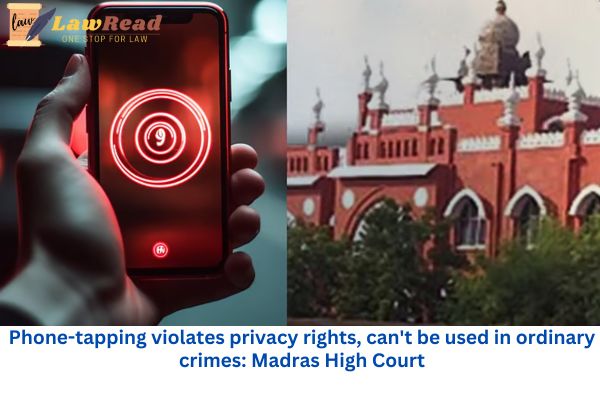
In cases of public emergency or for the sake of public safety, phone tapping is permitted under Section 5(2) of the Indian Telegraph Act, 1885.
On Wednesday, the Madras High Court ruled in P Kishore v. The Secretary to Government that phone tapping is an infringement on the fundamental right to privacy unless it is supported by a legally mandated process.
Judge N. Anand Venkatesh noted that while Section 5(2) of the Indian Telegraph Act, 1885, allows for phone tapping in emergency situations or for public safety, the language of the clause shouldn't be interpreted to include routine criminal investigations.
"The right to privacy is now a fundamental component of the personal liberty and right to life that are protected by Article 21 of the Indian Constitution. If not supported by a legally mandated process, telephone tapping is a violation of the right to privacy. The Court noted that while Section 5(2) of the Act permits telephone interception in the event of a public emergency or in the interest of public safety, the language of that section cannot be interpreted to cover the identification of routine criminal activity.
A 2011 decision from the Union Ministry of Home Affairs allowing the Central Bureau of Investigation (CBI) to tap the mobile phone of petitioner P Kishore, who was the managing director of Everonn Education Limited at the time, was being challenged at a plea hearing.
Based on a First Information Report (FIR) filed in August 2011 that listed Kishore as one of the defendants, the interception was connected to a CBI investigation. According to the FIR, Kishore was asked to pay ₹50 lakh to Andasu Ravinder, an IRS officer who was acting as the Additional Commissioner of Income Tax, in order to help the business avoid paying taxes. According to reports, Ravinder's friend Uttam Bohra was to handle the bribe.
The CBI acted upon the information by stopping Ravinder and Bohra close to the former's home and seizing a carton that contained ₹50 lakh. Neither of them could explain the money in a way that made sense. Notably, no money was found on Kishore, and he was not at the scene.
According to Article 21 of the Constitution, Kishore claimed that the phone-tapping order infringed upon his basic right to privacy. He argued that there were no legal requirements for this kind of surveillance, particularly the presence of a public emergency or a danger to public safety.
The Supreme Court's ruling in People's Union for Civil Liberties v. Union of India (PUCL case) and Rule 419-A of the Telegraph Rules' procedural protections were also violated, he claimed.
In defense of the order, the Center and CBI said that the interception was required to stop and look into corruption, which they said was a danger to public safety.
The Court, however, dismissed this claim, arguing that a reading this expansive would weaken the fundamental safeguard for the right to private.
In actuality, it seems blatantly erroneous to apply Section 5(2) of the Act to identify the conduct of routine offenses that do not fall under the purview of a public emergency or the interests of public safety. Such authority has been specifically granted in cases when phone tapping has been determined to be required to combat crimes, such as in certain special statutes such as the Maharashtra Control of Organized Crime Act, 1999. In order to investigate organized crime, Section 14 of the aforementioned Act permits the interception of wire, electronic, or oral communications. It is not possible to interpret Section 5(2) of the Act to encompass the detection of common crimes.
The Court noted that there was no true application of mind in the phone-tapping order, which just restated Section 5(2) of the Telegraph Act without citing any facts.
"When an Authority is required to set out its satisfaction while passing an order, the order must disclose that there has been application of mind to the facts of the case," it noted.
The Court further stated that, under current legislation, phone tapping without a "public emergency" or concern for "public safety" cannot be justified, regardless of how admirable or well-intentioned the goal.
It also pointed out that, contrary to the PUCL case, the tapped evidence was not presented to a Review Committee.
"The very fact that the intercepted material was not even placed before the Review Committee for its scrutiny would show that the respondents have clearly acted in brazen violation of the law."
As a result, the Court ruled that all telephone conversations intercepted in accordance with the August 2011 interception order were invalid and revoked the order.
The Court did clarify, though, that its ruling would not affect any evidence the CBI collected separately from the intercepted call records in the broader corruption investigation, and that the trial court should consider such material on its own merits.
The petitioner was represented by attorneys Rajagopal Vasudevan and Sharath Chandran.
Advocate TV Krishnamachari accompanied Additional Solicitor General ARL Sundaresan in representing the Union.
K Srinivasan, an advocate, represented the CBI.