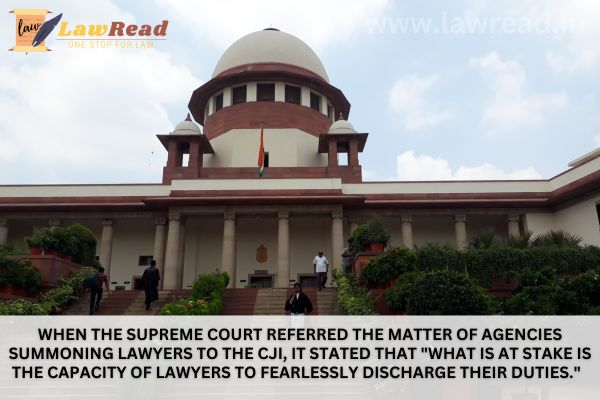
When the Supreme Court referred the matter of agencies summoning lawyers to the CJI, it stated that "what is at stake is the capacity of lawyers to fearlessly discharge their duties."
The Court forwarded the matter to the Chief Justice of India for consideration, stating that requiring attorneys to appear before investigating bodies in order to perform their professional obligations posed a major threat to judicial independence.
The Supreme Court noted that forcing attorneys to go before the police compromises the independence of the legal profession and prevented the Gujarat Police from calling an advocate for interrogation in a criminal case involving his client. The Court sent the matter to the Chief Justice of India for proper listing and consideration after formulating two legal questions regarding the validity of such summonses.
"What is at stake is the effectiveness of the administration of justice and the capacity of the lawyers to conscientiously and fearlessly discharge their professional duties," said a bench consisting of Justices K.V. Viswanathan and N. Kotiswar Singh. It seems utterly unacceptable to submit the counsel in a matter to the whims of the investigating, prosecuting, or police agencies.
The Court further stated that "it would seriously undermine the autonomy of the legal provision and would even constitute a direct threat to the independence of the administration of justice to permit the Investigating Agencies/Prosecuting Agency/Police to directly summon defense counsel or advocates, who advise parties in a given case."
On behalf of the petitioner, Senior Advocate Siddharth H. Dave made an appearance.
A Few Facts
Regarding a FIR involving a client he represented, the Gujarat Police served the petitioner, a practicing advocate, with a notice under Section 160 CrPC. Sections 323, 504, 506(2), 354, 354(A)(2), and 114 of the IPC were cited in the FIR as offenses.
The petitioner argued that he was not being called for any role as an accused person, but only because he was serving as counsel in the case. He petitioned the Supreme Court to shield him against coercive actions that, in his view, compromised the autonomy of his professional position.
The Court's reasoning
Since the Petitioner was a lawyer involved in the criminal case in question, the Court carefully considered the notice's legal and constitutional implications. The Bench noted that the issue brings up more general issues pertaining to the independence of the legal profession and the foundation of the legal system.
The Bench noted, "The legal profession is an integral component of the process of administration of justice," acknowledging the constitutional position of practicing attorneys. In addition to their fundamental rights under Article 19(1)(g) of the Indian Constitution, attorneys who practice law are entitled to specific rights and privileges because they are legal professionals and because of laws like Section 132 of the BSA.
"Permitting the Investigating Agencies/Prosecuting Agency/Police to directly summon defense counsel or Advocates, who advise parties in a given case would seriously undermine the autonomy of the legal provision and would even constitute a direct threat to the independence of the administration of justice," the Bench warned, acknowledging the improperness of allowing police to directly summon attorneys acting in their professional capacities.
The Court pointed out that any such investigation could impede the fundamental operations of the legal profession if it is conducted without judicial supervision. "The effectiveness of the administration of justice and the attorneys' ability to diligently and fearlessly carry out their professional duties are at stake," the Court continued.
The Bench declared that it was totally unacceptable to put attorneys under investigative pressure in this way. It also pointed out that in the rare event that a lawyer's role extends beyond professional representation, such actions must be evaluated by the courts rather than by the police on their own.
Given the issue's constitutional and systemic importance, the Court formulated two legal questions for decision-making:
"(i) Could the Investigating Agency, Prosecuting Agency, or Police directly call a lawyer for questioning if that person is only associated with the case as a lawyer advising the party?"
(ii) Should they be directly allowed to summon or should court oversight be mandated for such exceptional type of cases, even if the Investigating Agency, Prosecuting Agency, or Police have a case that the individual's duty is more than just that of a lawyer?
"Until further orders, the respondent-State is restrained from summoning the petitioner and there shall be stay of operation of the notice," the Court ordered, acknowledging the gravity of the situation.
In order to receive assistance, the Court sent notice to the Chairman of the Bar Council of India, the Attorney General for India, and the Solicitor General of India. The Chief Justice of India was instructed to bring the case before him for proper listing and review by a suitable bench.
Title of Cause: State of Gujarat & Anr. v. Ashwinkumar Govindbhai Prajapati (Special Leave to Appeal (Crl.) No(s).9334/2025)
Look:
Petitioner: AOR Siddhant Sharma; Senior Advocate Siddharth H. Dave; Advocates Prafull Bhardwaj and Maulik Soni