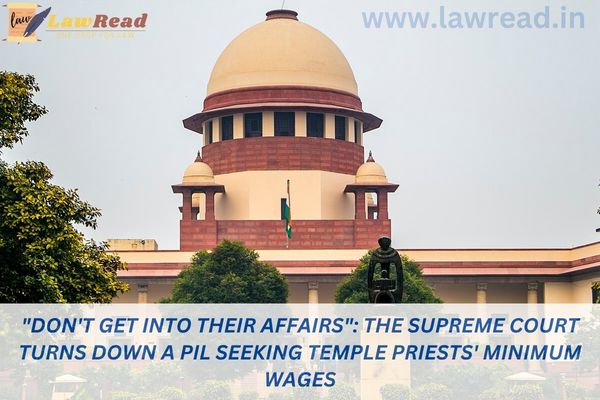
"Don't Get Into Their Affairs": The Supreme Court Turns Down a PIL Seeking Temple Priests' Minimum Wages
In accordance with Article 32 of the Constitution, a bench made up of Justices Vikram Nath and Sandeep Mehta declined to hear the case, arguing that people who are directly harmed by the wage arrangements should go to court on their own.
The top court cautioned the petitioner, advocate Ashwini Upadhyay, not to meddle with temple priests' administrative matters during the hearing, pointing out that he might not be entirely aware of the true salaries of priests and "sevadars."
In the end, the bench allowed Upadhyay to withdraw the petition, giving him the freedom to seek other legal remedies.
Advocate Ashwani Dubey filed the plea, which requested clear instructions from the federal and state governments to form an expert panel to assess the monetary pay of temple employees.
The demand for a formal declaration designating temple priests and staff as "employees" under Section 2(k) of the Code on Wages, 2019 was a key component of the petition.
The petition claims that a formal employer-employee relationship is created when a state government takes over administrative, financial, and economic authority of a temple. According to the suit, it is against Article 21 of the Indian Constitution to deny these workers a respectable salary.
at order to guarantee that temple priests at state-run establishments may maintain a respectable level of living, Upadhyay cited earlier decisions from the Allahabad High Court and other high courts that demanded a reevaluation of their pay.
The petitioner stated that his journey to Varanasi on April 4 for a public presentation was the immediate cause of action for the case. Upadhyay allegedly discovered that the priests and employees of the renowned, state-run Kashi Vishwanath temple were not getting the bare minimum pay necessary to live with dignity after carrying out a "rudrabhishek" ceremony there.
According to the petition, the state is failing to operate as a model employer through its various departments, classifying the situation as "systemic exploitation." It claimed that governments are deliberately breaking the Minimum Wages Act and the Directive Principles of State Policy (particularly Article 43) by paying employees less than the state-mandated minimum wage for unskilled and semi-skilled workers.
The petition emphasized growing labor unrest and legislative shifts in southern states to underscore the severity of the issue:
Mass Protests: Priests and temple employees in Andhra Pradesh and Telangana staged recent large-scale demonstrations to call for fundamental minimum wage rights.
Cost of Living Adjustments: According to the petition, temple employees have been further marginalized by the ongoing failure to match wages with the 2026 inflation-adjusted cost of living index.
The "Dakshina" Ban: On February 7, 2025, a Tamil Nadu government issued a circular at the Dandayuthapani Swami Temple in Madurai, exacerbating the fragile nature of these livelihoods. The regulation cut off a customary source of additional revenue by rigorously forbidding priests from taking dakshina (voluntary monetary contributions) in aarti plates.
The Supreme Court maintained that any legal challenge pertaining to these grievances must be filed directly by the impacted temple employees rather than through third-party public interest action in spite of these grounds.
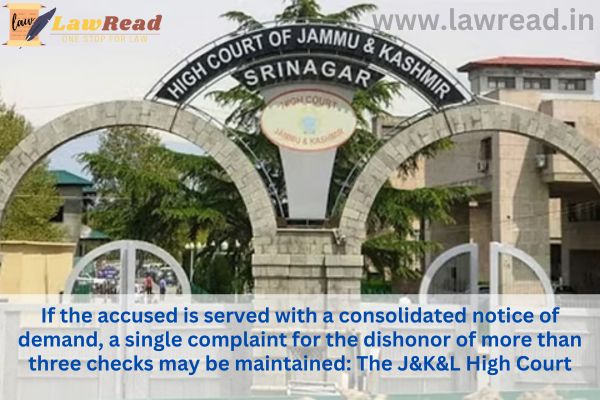
If the accused is served with a consolidated notice of demand, a single complaint for the dishonor of more than three checks may be maintained: The J&K&L High Court
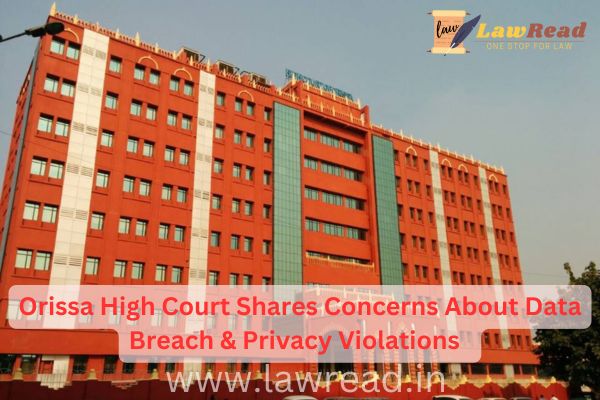
Orissa High Court Shares Concerns About Data Breach & Privacy Violations While Upholding Mandatory PAN-Aadhaar Linking For Demat Accounts
The Supreme Court dismisses the case against a public servant, stating that S. 197 CrPC does not envision the concept of "deemed sanction."
Community Invitation
Enjoying LawRead?
You've been reading on LawRead! Create a free student or advocate account to unlock our complete legal platform:
Premium Courses & Mock TestsJudiciary, UGC-NET, and Bar examination lecture bundles, video classes, and structured notes.
Community Discussion ForumAsk legal questions, reply to ongoing case discussions, and connect with legal scholars and peers.
Unlimited PDF DownloadsDownload Bare Acts, landmark judgments, study notes, and legal updates without any limit.
Already have an account?•
Sign in to LawRead
Free Download Limit Reached (2 of 2 used)
Sign in or create a free account to download this PDF and enjoy unlimited access across all Bare Acts, Notes & Judgements.