The Chhattisgarh High Court ruled that government schools cannot force students to recite Hindu prayers.
A case contesting a State government circular requiring the recitation of Saraswati Vandana, Gayatri Mantra, and other prayers at government schools was being heard by the court.
In the case of Abdul Salam Rizvi & Ors. v. State of Chhattisgarh & Ors., the Chhattisgarh High Court clarified on Thursday that no child may be forced to say Hindu prayers in government schools.
A lawsuit contesting a June 12 State government circular requiring Saraswati Vandana, Gayatri Mantra, Guru Mantra, and other Hindu prayers in schools was being heard by the court.
The State administration submitted to Justice Amitendra Kishore Prasad that, notwithstanding the circular's issuance in early June, its implementation had not yet begun. In light of this declaration, the Court dismissed the case while allowing the petitioners to reapply to the Court in the event that it is determined that any kid was forced to take part in the prayers.
Additionally, the Court noted that if any such compulsion is brought to its attention, appropriate action will be taken. We are awaiting a complete order.
Amitendra Kishore Prasad, Justice
Former chairman of the Chhattisgarh Waqf Board Abdul Salam Rizvi, former head of the Minority Department Mahendra Chhabda, and social activist Shafique Ahmed of Bilaspur filed the petition, contesting the constitutionality of the circular issued by the School Education Department.
The State's circular mandated that the National Anthem, National Song, Deep Mantra, Saraswati Vandana, and Guru Mantra be recited in government schools throughout the State. Additionally, it required reading biographies of notable figures, the Gayatri and Shanti mantras prior to distribution, and the Bhojan mantra during midday meals.
The petition argued that the circular had infringed upon fundamental rights protected by the Constitution as well as secularism.In government schools, the mandated teaching of Saraswati Vandana, Gayatri Mantra, Guru Mantra, and Shanti Mantra amounts to religious instruction and the propagation of a specific faith. Therefore, the contested order is unconstitutional," the plea stated.
Additionally, the petitions claimed that students who did not want to take part in religious observances were not protected by the circular.It argued that neither an exemption mechanism nor the freedom of conscience of students who might not want to engage in such religious activities are protected by the contested decree.
The appeal further claimed that by favoring the practices of one religion over another, the circular violated the State's duty to uphold religious neutrality. It said, "By prescribing prayers and mantras associated with one religion while excluding all others, the State creates an impermissible preference and classification based upon religion."
The circular was irreconcilable with the secular nature of public education, the petitioners continued.The appeal stated, "The State's action effectively promotes and institutionalizes religious practices of one faith in State-funded educational institutions, thereby violating constitutional guarantees."
The petitioners were represented by attorneys Sitara Khan and Aamir Khan.
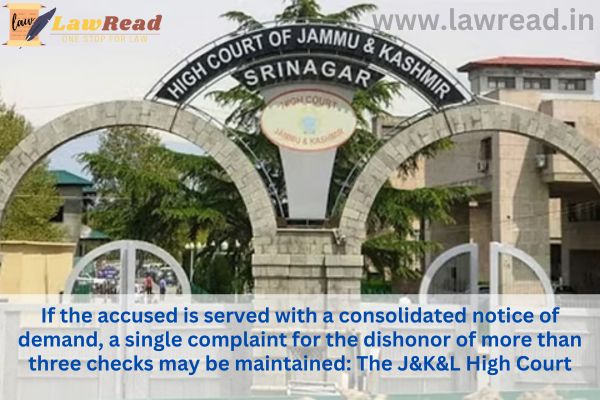
If the accused is served with a consolidated notice of demand, a single complaint for the dishonor of more than three checks may be maintained: The J&K&L High Court
Orissa High Court Shares Concerns About Data Breach & Privacy Violations While Upholding Mandatory PAN-Aadhaar Linking For Demat Accounts
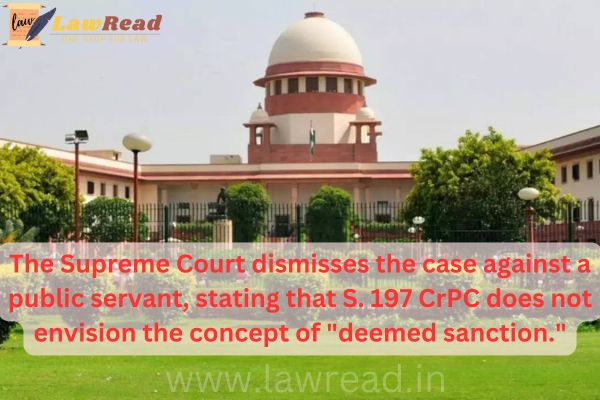
The Supreme Court dismisses the case against a public servant, stating that S. 197 CrPC does not envision the concept of "deemed sanction."
Community Invitation
Enjoying LawRead?
You've been reading on LawRead! Create a free student or advocate account to unlock our complete legal platform:
Premium Courses & Mock TestsJudiciary, UGC-NET, and Bar examination lecture bundles, video classes, and structured notes.
Community Discussion ForumAsk legal questions, reply to ongoing case discussions, and connect with legal scholars and peers.
Unlimited PDF DownloadsDownload Bare Acts, landmark judgments, study notes, and legal updates without any limit.
Already have an account?•
Sign in to LawRead
Free Download Limit Reached (2 of 2 used)
Sign in or create a free account to download this PDF and enjoy unlimited access across all Bare Acts, Notes & Judgements.

.jpg)