After 36 years of separation, the Jharkhand High Court awards the wife ₹40L in permanent alimony, stating that "no purpose will be served in sailing the dead wood."
The Bench took into account the husband's retirement benefits of around ₹38 lakh together with pensionary benefits, as well as the wife's age, lack of independent income, future medical demands, inflation, and reliance on alimony.
The Jharkhand High Court ordered the husband, a railway employee, to pay ₹40 lakh in one-time permanent alimony, upholding the divorce of a 42-year-old marriage while improving the financial relief given to the woman.
As a result, the husband was ordered by the court to pay ₹40 lakh in permanent alimony in four equal installments over the course of a year, with the first installment due within one month of the order's date. The Bench noted that the marriage had turned into a "dead wood marriage" after 36 years of separation and that forcing the parties to stay together would be pointless.
A Division Bench made up of Justices Sanjay Prasad and Sujit Narayan Prasad noted, "In the aforementioned circumstances, the considered view of this Court is that now the marital relation between the parties has become "dead wood marriage" and has become lifeless and without emotional or practical value."
It is a well-established legal principle that when a marriage is judged to be dead wood, the courts may grant a divorce because they understand that keeping a couple in such a relationship will only make their suffering worse and that sailing the dead wood will serve no purpose.
Advocate Ritu Kumar represented the respondent, while Advocate Shadab Bin Haque represented the appellant. The Family Court of Jamtara's decision to dissolve her marriage to the respondent under Sections 13(1)(ia) and 13(1)(ib) of the Hindu Marriage Act, 1955 on the grounds of cruelty and desertion was appealed.
The couple had a daughter after being married on May 29, 1984. Despite numerous attempts at reconciliation, the husband claims that the wife left the marital residence in 1990 and moved in with her parents. He argued that she had also started a maintenance proceeding in which he agreed to pay monthly support and criminal proceedings under Section 498A IPC, which were eventually settled.
However, the wife claimed that her husband had abandoned her and that she was forced to live apart because of his suspected involvement with another woman. She contended that the ₹10 lakh permanent alimony awarded was insufficient given the husband's salary and upcoming retirement benefits, and that the Family Court had failed to appropriately evaluate the facts.
The High Court acknowledged that the parties had been living apart for almost 36 years and that there was little chance of reconciliation while upholding the divorce decision. The Court noted that permanence of separation is a crucial component of the idea of desertion and concluded that the extended duration of separation showed that the marital partnership had lost its emotional and practical worth.
The Court also looked at the question of permanent alimony under Section 25 of the Hindu Marriage Act and concluded that criteria such the parties' income, standard of life, financial ability, liabilities, and future needs of the spouse must be taken into account while determining maintenance.
The husband, a Senior Technician (M.V. Driver) at Chittaranjan Locomotive Works, was scheduled to retire on August 31, 2026, and the Bench noted that he would earn pensionary benefits in addition to retirement payments of about ₹38 lakh. The Court determined that ₹40 lakh would be a fair and reasonable sum given the wife's age, lack of independent income, future medical demands, inflation, and reliance on alimony.
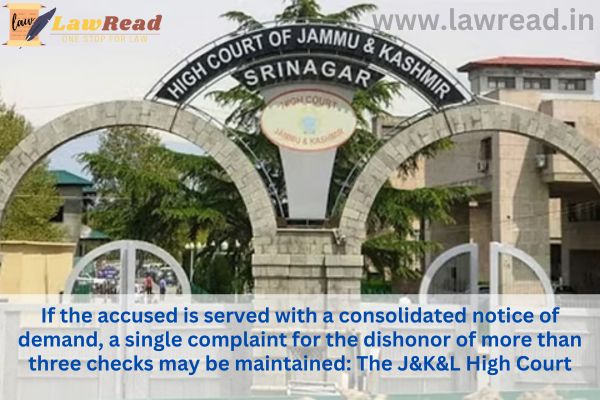
If the accused is served with a consolidated notice of demand, a single complaint for the dishonor of more than three checks may be maintained: The J&K&L High Court
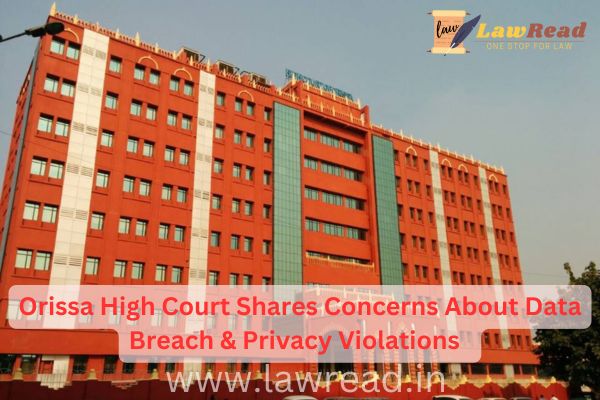
Orissa High Court Shares Concerns About Data Breach & Privacy Violations While Upholding Mandatory PAN-Aadhaar Linking For Demat Accounts
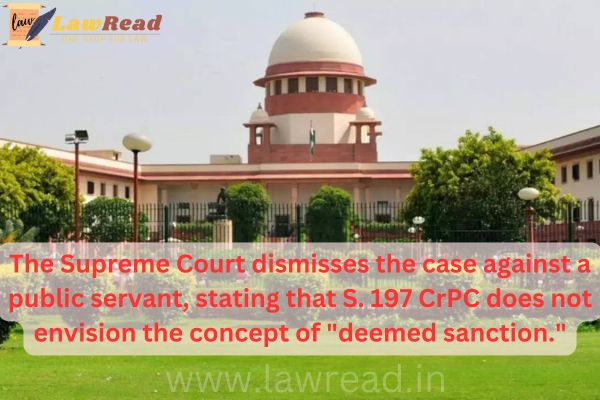
The Supreme Court dismisses the case against a public servant, stating that S. 197 CrPC does not envision the concept of "deemed sanction."
Community Invitation
Enjoying LawRead?
You've been reading on LawRead! Create a free student or advocate account to unlock our complete legal platform:
Premium Courses & Mock TestsJudiciary, UGC-NET, and Bar examination lecture bundles, video classes, and structured notes.
Community Discussion ForumAsk legal questions, reply to ongoing case discussions, and connect with legal scholars and peers.
Unlimited PDF DownloadsDownload Bare Acts, landmark judgments, study notes, and legal updates without any limit.
Already have an account?•
Sign in to LawRead
Free Download Limit Reached (2 of 2 used)
Sign in or create a free account to download this PDF and enjoy unlimited access across all Bare Acts, Notes & Judgements.

.jpg)